

Recently, the China Telecom Cloud Computing Research Institute achieved new progress in the field of edge visual perception. A research paper titled "Learning Robust Representation from Imbalanced Event Streams with Adaptive STDP", authored by Dr. Junwei Zhao, has been accepted for presentation at the European Conference on Artificial Intelligence (ECAI) 2025, a major international conference in the field of artificial intelligence (categorized as CCF-B). The paper tackles the challenge of visual perception for moving objects and proposes a novel processing algorithm for event cameras. The approach aims to enhance the robustness and accuracy of object recognition in high-speed motion scenarios, offering a new technical pathway for object perception in UAV applications.
During high-speed UAV flights, traditional frame-based cameras are often constrained by limitations in frame rate and imaging mechanisms, resulting in motion blur and exposure artifacts. In recent years, event cameras have emerged as a promising alternative due to their microsecond-level temporal resolution and high dynamic range. These sensors asynchronously capture pixel-level brightness changes and are well-suited for perceiving fast-moving scenes. To address the limitations of polarity imbalance in event data, this study proposes a representation learning method based on an adaptive spike-timing-dependent plasticity (STDP) mechanism. The method effectively mitigates the impact of event polarity imbalance and improves the accuracy of object recognition under dynamic conditions, providing a new edge-cloud collaborative perception framework for UAV-based sensing.
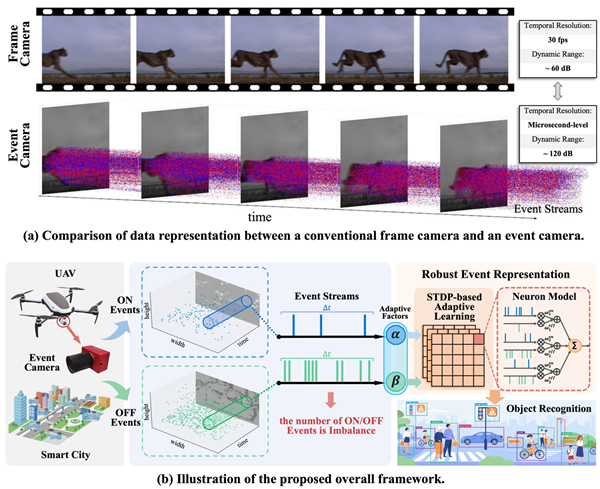 Illustration of the main content
Since its establishment in 1974, ECAI has become a prominent international forum for research in artificial intelligence. ECAI 2025 received a total of 2,667 valid submissions, of which 626 were accepted, resulting in an acceptance rate of approximately 23%. The conference covers a broad range of topics, including machine learning, computer vision, natural language processing, and embodied intelligence, and will be held from October 25 to 30, 2025, in Bologna, Italy.
As a key research institution for technological innovation under China Telecom, the China Telecom Cloud Computing Research Institute continues to advance key techniques of the "Intelligent Ubiquitous Cloud". The institute conducts research and innovation in response to complex, dynamic, and real-time computing scenarios. The acceptance of this research paper further enriches the institute’s technical portfolio in edge intelligent perception and contributes to the development of intelligent applications in emerging scenarios characterized by low latency and high dynamics.

China Telecom Cloud Computing Research Institute Beijing Headquarters
(No. 42, Xueyuan Road, Haidian District, Beijing)
China Telecom Cloud Computing Research Institute Shanghai Branch (No. 211, Century Avenue, Pudong New Area, Shanghai)
Beijing Public Security Registration No. 11040140060 | Beijing ICP No. 12007914
Value-Added Telecommunications Business Operation License A2.B1.B2-20090001


Recently, the China Telecom Cloud Computing Research Institute achieved new progress in the field of edge visual perception. A research paper titled "Learning Robust Representation from Imbalanced Event Streams with Adaptive STDP", authored by Dr. Junwei Zhao, has been accepted for presentation at the European Conference on Artificial Intelligence (ECAI) 2025, a major international conference in the field of artificial intelligence (categorized as CCF-B). The paper tackles the challenge of visual perception for moving objects and proposes a novel processing algorithm for event cameras. The approach aims to enhance the robustness and accuracy of object recognition in high-speed motion scenarios, offering a new technical pathway for object perception in UAV applications.
During high-speed UAV flights, traditional frame-based cameras are often constrained by limitations in frame rate and imaging mechanisms, resulting in motion blur and exposure artifacts. In recent years, event cameras have emerged as a promising alternative due to their microsecond-level temporal resolution and high dynamic range. These sensors asynchronously capture pixel-level brightness changes and are well-suited for perceiving fast-moving scenes. To address the limitations of polarity imbalance in event data, this study proposes a representation learning method based on an adaptive spike-timing-dependent plasticity (STDP) mechanism. The method effectively mitigates the impact of event polarity imbalance and improves the accuracy of object recognition under dynamic conditions, providing a new edge-cloud collaborative perception framework for UAV-based sensing.
Illustration of the main content
Since its establishment in 1974, ECAI has become a prominent international forum for research in artificial intelligence. ECAI 2025 received a total of 2,667 valid submissions, of which 626 were accepted, resulting in an acceptance rate of approximately 23%. The conference covers a broad range of topics, including machine learning, computer vision, natural language processing, and embodied intelligence, and will be held from October 25 to 30, 2025, in Bologna, Italy.
As a key research institution for technological innovation under China Telecom, the China Telecom Cloud Computing Research Institute continues to advance key techniques of the "Intelligent Ubiquitous Cloud". The institute conducts research and innovation in response to complex, dynamic, and real-time computing scenarios. The acceptance of this research paper further enriches the institute’s technical portfolio in edge intelligent perception and contributes to the development of intelligent applications in emerging scenarios characterized by low latency and high dynamics.
