

Recently, the China Telecom Cloud Computing Research Institute, in collaboration with Jiangsu Telecom Unmanned Technology Co., Ltd., has made significant progress in the field of edge visual perception. The jointly authored research paper titled “HDCFN: Haze Distribution-aware Cross-modal Fusion Network for Infrared-guided Dense Haze Removal in UAVs” has been accepted as a full paper by ACM Multimedia 2025, a leading international conference in the field of multimedia (CCF-A). This study tackles challenges in visual perception for low-altitude economic applications and provides technical support to improve the operational continuity and safety of UAVs under complex weather conditions.
With the rapid development of the low-altitude economy, there is an increasing demand for UAVs to maintain continuous operation in challenging environments. In particular, visual degradation caused by haze has become a key technical constraint for UAV deployment and application. In response, the research team proposed HDCFN, a haze-distribution-aware cross-modal fusion method. This approach leverages the structural perception capabilities of infrared imagery and employs an adaptive fusion mechanism to dynamically enhance the visual features of the visible-light modality. The method improves scene restoration capabilities for edge devices operating in adverse weather, thereby enhancing the robustness of on-board perception systems and laying a technical foundation for intelligent edge-cloud collaborative sensing.
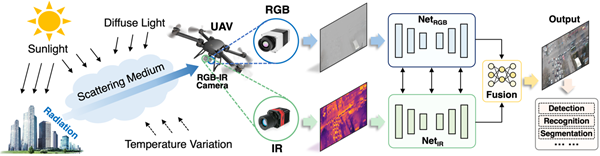 Illustration of the overall framework
In August 2024, Jie Wu, President of the China Telecom Cloud Computing Research Institute, visited Jiangsu Telecom Unmanned Technology Co., Ltd. During the visit, he held in-depth discussions with General Manager Haifeng Shan on the application of key technologies such as edge-cloud intelligence and multimodal computation in the low-altitude economy. Based on this visit, the two parties reached a cooperation intention and rapidly advanced joint research efforts. The paper’s acceptance at ACM MM 2025 marks the first representative achievement of this collaboration. The paper was co-authored by Researcher Junwei Zhao, Chief Scientist Jie Wu, R&D Director Qianchun Luo from Jiangsu Telecom Unmanned Technology Co., Ltd., and Researcher Shen Gao from the Cloud Computing Research Institute. This outcome highlights the effective integration of research and application and contributes new momentum to technological innovation in the low-altitude economy.
As a core platform for technological innovation within China Telecom, the Cloud Computing Research Institute has strategically focused on edge-cloud intelligence and multimodal computation within the broader initiative of “Intelligent Ubiquitous Cloud”. This research direction provides a technological anchor for edge AI applications in low-altitude economic scenarios. Building on such innovations, China Telecom could further empower UAV applications in areas such as intelligent inspection and low-altitude logistics, enhancing operational continuity and reliability under complex weather conditions and supporting the high-quality development of the low-altitude economy.
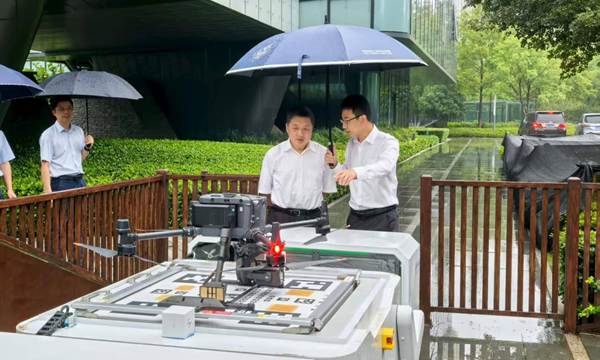 General Manager Haifeng Shan introduces the UAV cabin system to Professor Jie Wu

China Telecom Cloud Computing Research Institute Beijing Headquarters
(No. 42, Xueyuan Road, Haidian District, Beijing)
China Telecom Cloud Computing Research Institute Shanghai Branch (No. 211, Century Avenue, Pudong New Area, Shanghai)
Beijing Public Security Registration No. 11040140060 | Beijing ICP No. 12007914
Value-Added Telecommunications Business Operation License A2.B1.B2-20090001


Recently, the China Telecom Cloud Computing Research Institute, in collaboration with Jiangsu Telecom Unmanned Technology Co., Ltd., has made significant progress in the field of edge visual perception. The jointly authored research paper titled “HDCFN: Haze Distribution-aware Cross-modal Fusion Network for Infrared-guided Dense Haze Removal in UAVs” has been accepted as a full paper by ACM Multimedia 2025, a leading international conference in the field of multimedia (CCF-A). This study tackles challenges in visual perception for low-altitude economic applications and provides technical support to improve the operational continuity and safety of UAVs under complex weather conditions.
With the rapid development of the low-altitude economy, there is an increasing demand for UAVs to maintain continuous operation in challenging environments. In particular, visual degradation caused by haze has become a key technical constraint for UAV deployment and application. In response, the research team proposed HDCFN, a haze-distribution-aware cross-modal fusion method. This approach leverages the structural perception capabilities of infrared imagery and employs an adaptive fusion mechanism to dynamically enhance the visual features of the visible-light modality. The method improves scene restoration capabilities for edge devices operating in adverse weather, thereby enhancing the robustness of on-board perception systems and laying a technical foundation for intelligent edge-cloud collaborative sensing.
Illustration of the overall framework
In August 2024, Jie Wu, President of the China Telecom Cloud Computing Research Institute, visited Jiangsu Telecom Unmanned Technology Co., Ltd. During the visit, he held in-depth discussions with General Manager Haifeng Shan on the application of key technologies such as edge-cloud intelligence and multimodal computation in the low-altitude economy. Based on this visit, the two parties reached a cooperation intention and rapidly advanced joint research efforts. The paper’s acceptance at ACM MM 2025 marks the first representative achievement of this collaboration. The paper was co-authored by Researcher Junwei Zhao, Chief Scientist Jie Wu, R&D Director Qianchun Luo from Jiangsu Telecom Unmanned Technology Co., Ltd., and Researcher Shen Gao from the Cloud Computing Research Institute. This outcome highlights the effective integration of research and application and contributes new momentum to technological innovation in the low-altitude economy.
As a core platform for technological innovation within China Telecom, the Cloud Computing Research Institute has strategically focused on edge-cloud intelligence and multimodal computation within the broader initiative of “Intelligent Ubiquitous Cloud”. This research direction provides a technological anchor for edge AI applications in low-altitude economic scenarios. Building on such innovations, China Telecom could further empower UAV applications in areas such as intelligent inspection and low-altitude logistics, enhancing operational continuity and reliability under complex weather conditions and supporting the high-quality development of the low-altitude economy.
General Manager Haifeng Shan introduces the UAV cabin system to Professor Jie Wu
