

On November 5, 2024, Jie Wu, Chief Scientist of China Telecom and President of the Cloud Computing Research Institute, was invited to attend the China-Japan-Korea Forward-Looking Program Seminar held in Beijing. The theme of the seminar was "AI-based Future IoT Technologies and Services," bringing together top experts from the telecommunications sectors of China, Japan, and Korea to explore future technologies and innovative services in applying artificial intelligence (AI) to the Internet of Things (IoT). The seminar aimed to promote cross-national scientific collaboration and advance high-end research in Asia, attracting participation from prestigious universities and research institutions across the three countries.
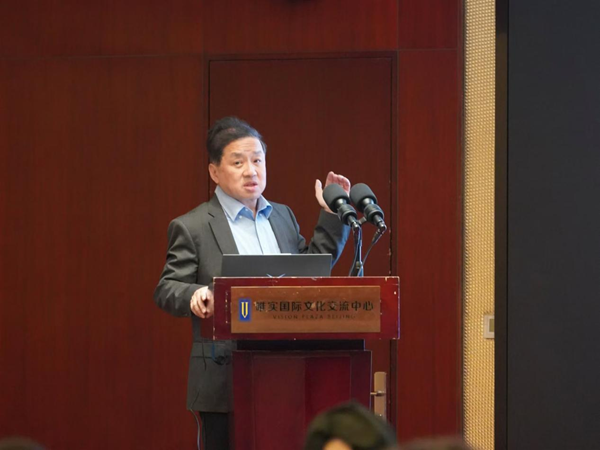
At the seminar, Wu Jie delivered a keynote report titled "Optimal Offloading of Deep Neural Networks from IoT Devices to the Cloud," in which he discussed the best methods for offloading deep neural network (DNN) tasks from IoT devices to the cloud in IoT environments. His research analyzed the phased processing flow of DNN computations, pointing out that the local computation time on devices increases linearly with the computational load, while the cloud-based computation time follows a monotonically decreasing convex curve. This finding is crucial for determining the optimal offloading stage to minimize overall computation time. The report further introduced optimization methods for DNN offloading for both linear and general structures, validating the effectiveness of the proposed solutions through real-world system testing, which received high praise from the attending experts.
The seminar invited scholars from well-known universities and institutions in China, Japan, and Korea, including Professor Fumiyuki Adachi and Professor Nei Kato from Tohoku University, Japan, which has ranked first in the Times Higher Education rankings for Japanese universities for four consecutive years; Professor Saewoong Bahk from Seoul National University, Korea; and Professor Ma Huadong from Beijing University of Posts and Telecommunications, often referred to as the "Harvard of Information." Experts from Nanjing University of Aeronautics and Astronautics, Shanghai Jiao Tong University, Keio University, Waseda University, Yonsei University, and Pohang University of Science and Technology also gathered to share their latest research results in the fields of IoT and AI.
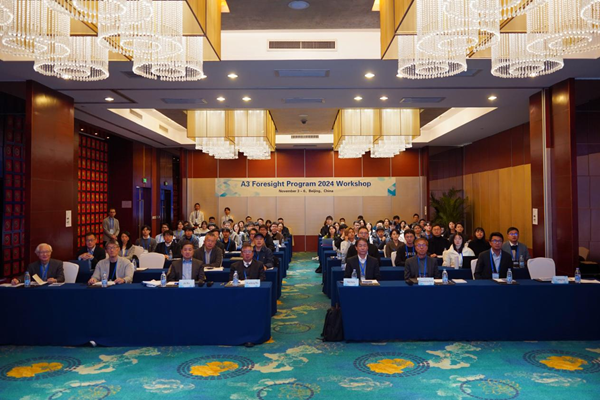
This seminar was supported by the China-Japan-Korea (A3) Forward-Looking Program, a collaborative project established by the Natural Science Foundations of China, Japan, and Korea. The aim of the program is to foster close cooperation among the top research teams from the three countries and build a high-level research center in Asia. The A3 Forward-Looking Program, based on agreements between the National Natural Science Foundation of China (NSFC), the Japan Society for the Promotion of Science (JSPS), and the National Research Foundation of Korea (NRF), supports collaborative cutting-edge technology research, facilitating resource sharing and driving innovative breakthroughs.

China Telecom Cloud Computing Research Institute Beijing Headquarters
(No. 42, Xueyuan Road, Haidian District, Beijing)
China Telecom Cloud Computing Research Institute Shanghai Branch (No. 211, Century Avenue, Pudong New Area, Shanghai)
Beijing Public Security Registration No. 11040140060 | Beijing ICP No. 12007914
Value-Added Telecommunications Business Operation License A2.B1.B2-20090001


On November 5, 2024, Jie Wu, Chief Scientist of China Telecom and President of the Cloud Computing Research Institute, was invited to attend the China-Japan-Korea Forward-Looking Program Seminar held in Beijing. The theme of the seminar was "AI-based Future IoT Technologies and Services," bringing together top experts from the telecommunications sectors of China, Japan, and Korea to explore future technologies and innovative services in applying artificial intelligence (AI) to the Internet of Things (IoT). The seminar aimed to promote cross-national scientific collaboration and advance high-end research in Asia, attracting participation from prestigious universities and research institutions across the three countries.
At the seminar, Wu Jie delivered a keynote report titled "Optimal Offloading of Deep Neural Networks from IoT Devices to the Cloud," in which he discussed the best methods for offloading deep neural network (DNN) tasks from IoT devices to the cloud in IoT environments. His research analyzed the phased processing flow of DNN computations, pointing out that the local computation time on devices increases linearly with the computational load, while the cloud-based computation time follows a monotonically decreasing convex curve. This finding is crucial for determining the optimal offloading stage to minimize overall computation time. The report further introduced optimization methods for DNN offloading for both linear and general structures, validating the effectiveness of the proposed solutions through real-world system testing, which received high praise from the attending experts.
The seminar invited scholars from well-known universities and institutions in China, Japan, and Korea, including Professor Fumiyuki Adachi and Professor Nei Kato from Tohoku University, Japan, which has ranked first in the Times Higher Education rankings for Japanese universities for four consecutive years; Professor Saewoong Bahk from Seoul National University, Korea; and Professor Ma Huadong from Beijing University of Posts and Telecommunications, often referred to as the "Harvard of Information." Experts from Nanjing University of Aeronautics and Astronautics, Shanghai Jiao Tong University, Keio University, Waseda University, Yonsei University, and Pohang University of Science and Technology also gathered to share their latest research results in the fields of IoT and AI.
This seminar was supported by the China-Japan-Korea (A3) Forward-Looking Program, a collaborative project established by the Natural Science Foundations of China, Japan, and Korea. The aim of the program is to foster close cooperation among the top research teams from the three countries and build a high-level research center in Asia. The A3 Forward-Looking Program, based on agreements between the National Natural Science Foundation of China (NSFC), the Japan Society for the Promotion of Science (JSPS), and the National Research Foundation of Korea (NRF), supports collaborative cutting-edge technology research, facilitating resource sharing and driving innovative breakthroughs.
