

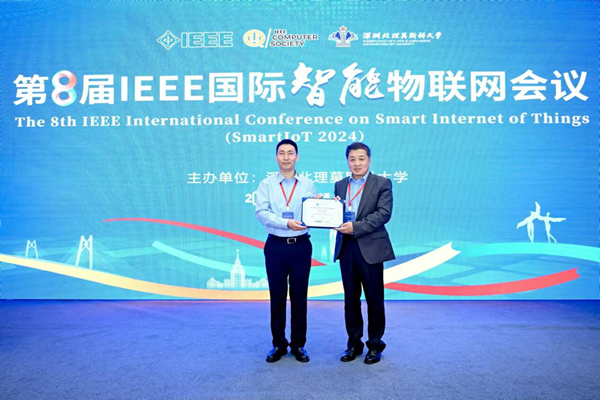
On November 15, 2024,Jie Wu, Chief Scientist of China Telecom and President of the Cloud Computing Research Institute, was invited to attend the 8th IEEE International Smart IoT Conference (SmartIoT 2024) in Shenzhen, where he delivered a keynote speech titled “Challenges and Opportunities in Re-Balancing of Bike Sharing Systems.”
In his speech, President Jie Wu discussed how to optimize smart city management and improve resource utilization efficiency. He approached the topic by addressing the practical issue of urban bike-sharing system scheduling, proposing that the design of such systems should consider facility locations, demand forecasting, the introduction of rebalancing strategies, and user guidance.
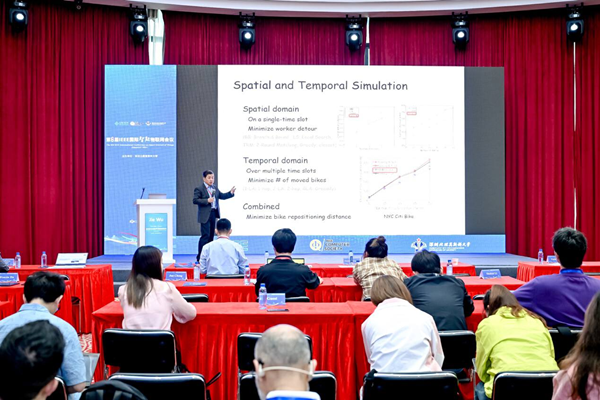
He then delved into theoretical methods for system rebalancing strategies, introducing various classical computer algorithms such as Hamiltonian cycles, greedy algorithms, minimum weight matching, and multi-round perfect matching to optimize bike-sharing system scheduling. He also analyzed the time and space complexity of each algorithm.
Finally, President Wu elaborated on the opportunities, challenges, and development trends of bike-sharing scheduling systems, pointing out that the solutions to this problem could be applied to larger-scale scenarios, such as low-altitude unmanned aerial vehicles.
The SmartIoT conference, organized by the IEEE Computer Society, has been successfully held for eight editions. The conference aims to promote the exchange and sharing of the latest research findings, theoretical discussions, and practical applications in the fields of smart IoT and cyber-physical systems.

China Telecom Cloud Computing Research Institute Beijing Headquarters
(No. 42, Xueyuan Road, Haidian District, Beijing)
China Telecom Cloud Computing Research Institute Shanghai Branch (No. 211, Century Avenue, Pudong New Area, Shanghai)
Beijing Public Security Registration No. 11040140060 | Beijing ICP No. 12007914
Value-Added Telecommunications Business Operation License A2.B1.B2-20090001


On November 15, 2024,Jie Wu, Chief Scientist of China Telecom and President of the Cloud Computing Research Institute, was invited to attend the 8th IEEE International Smart IoT Conference (SmartIoT 2024) in Shenzhen, where he delivered a keynote speech titled “Challenges and Opportunities in Re-Balancing of Bike Sharing Systems.”
In his speech, President Jie Wu discussed how to optimize smart city management and improve resource utilization efficiency. He approached the topic by addressing the practical issue of urban bike-sharing system scheduling, proposing that the design of such systems should consider facility locations, demand forecasting, the introduction of rebalancing strategies, and user guidance.
He then delved into theoretical methods for system rebalancing strategies, introducing various classical computer algorithms such as Hamiltonian cycles, greedy algorithms, minimum weight matching, and multi-round perfect matching to optimize bike-sharing system scheduling. He also analyzed the time and space complexity of each algorithm.
Finally, President Wu elaborated on the opportunities, challenges, and development trends of bike-sharing scheduling systems, pointing out that the solutions to this problem could be applied to larger-scale scenarios, such as low-altitude unmanned aerial vehicles.
The SmartIoT conference, organized by the IEEE Computer Society, has been successfully held for eight editions. The conference aims to promote the exchange and sharing of the latest research findings, theoretical discussions, and practical applications in the fields of smart IoT and cyber-physical systems.
